Summary
Sheep troughs get specified on adult measurements. Then lambing arrives.
A trough a ewe can use without thinking is often at the top of a lamb's reach. A lamb that has to stretch for water drinks less than it should. Over a few weeks that shows up in growth, not in the water bill.
The lamb water trough from Terrui is built around that limit. It publishes a 30 cm drinking height. That is just under twelve inches, at the low end of the 12 to 24-inch band the same page gives for sheep troughs generally.
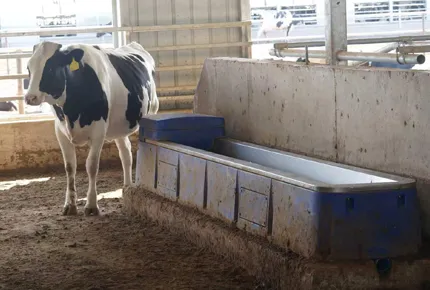
The rest of the numbers are as specific. 113 cm long, 49 cm wide, 45 cm overall height. 26 litres of stored capacity. A 40 litre-per-minute refill through a 1/2" braided hose.
The 1.7m version doubles the length and capacity. It keeps the same drinking height.
What a Lamb Water Trough Has to Do Differently
A ewe reaches over the lip and drops her head. Nothing about that is difficult. A lamb has a shorter neck and a smaller mouth. Its daily intake is small in absolute terms, and large relative to its own body.
The sheep trough page spends as much space on height as on volume. Set the trough too high and younger sheep may struggle to reach the water. The page states the consequence: inadequate hydration and potential health issues. Set it too low and the trough contaminates faster, which affects how clean the water stays.
Both failures are real. They pull opposite ways. The answer is a drinking edge low enough for a lamb, with a basin deep enough that debris and dirty water stay below the drinking line.
Terrui addresses the same point from the other side. It notes that its lamb water trough options are tailored to the smaller stature of young sheep, so drinking is not an effort.
The geometry makes it possible. On the 1.13m unit the drinking height and the overall height are 15 cm apart. A low edge, and still a basin with depth.
Why Height and Capacity Matter More Than Most Buyers Expect
The 12 to 24-inch figure is a band, not a number. Sheep breeds differ too much for precision. A small hill breed and a large terminal sire do not stand at the same shoulder height. A lamb crop changes height every few weeks.
Two consequences follow. Choose a position within the band that suits the smallest animals using the trough, not the largest. Then either move the trough as lambs grow, or run a separate lamb unit beside the adult one.
Capacity works differently. The 1.13m trough stores 26 litres. The 1.7m trough stores 60. Both refill at 40 litres per minute.
That flow rate is what makes a small basin viable. The stored volume does not have to carry a group through a whole drinking period. The float valve replaces what is taken.
Peak demand decides whether a trough feels adequate. Sheep drink in groups after feeding and after being moved. A trough that empties in that window and refills slowly creates a queue. Timid lambs lose that contest every time. The loss is invisible unless somebody watches the trough at the wrong moment of the day.
Access is the other half of capacity. At 113 cm long and 49 cm wide, the small unit gives one drinking edge. That suits a pen, a creep area or a small group.
Group size is the multiplier. A dozen lambs around one small trough is comfortable. Forty is not, however fast the valve delivers. The drinking edge is the limit, and no flow rate widens it.
Mixed flocks do better with two troughs at different heights than with one compromise unit. Terrui's catalogue reflects that. The 1.7m sheep trough runs 170 cm long with 60 litres. The livestock waterer range carries larger pasture units for flocks that need a longer edge.
On a mixed farm, lambs often run with cattle. A cattle drinker in the same paddock needs positioning so it does not pull lambs away from their own lower trough.
Position matters more than it looks. A trough with one drinking edge wants clear space in front. It wants to sit where the flock already walks. Rotating paddocks with electric sheep netting means setting the trough with the fence layout in mind, not moving the trough every time the fence moves.
How to Specify a Lamb Water Trough
Materials come first. Everything else depends on the body surviving the field.
Terrui describes the construction as food-grade, high-density polyethylene. The soundproofing layer is built with polymeric bubbling technology. The page lists extended service life, corrosion resistance, impact resistance and ultraviolet resistance as the results.
For young stock there is a second property. The page notes that the design helps keep sheep from being scratched or injured. In a pen of lambs that move at speed, that is not a small claim.
Cleaning decides how the trough performs in month six. Terrui's guidance on the heated drinker page is a thorough clean once a week. More frequent checks and rinses are advised as needed, especially in warmer weather, to prevent the build-up of algae, bacteria and debris.
A 26-litre basin empties and rinses quickly. That is part of why small troughs get cleaned more often than large ones. The habit is worth more than any material specification.
Height in a shed is easy to control. The floor is flat. Put the unit on a level base, check the drinking edge against the smallest lambs in the pen, and keep bedding away from the front.
Height in a field is harder. The ground is rarely level. A trough that sits correctly on the trailer can end up higher or lower once it is placed. Check it where it will actually stand.
The base deserves more thought than it gets. A trough on soft ground settles at one corner. A unit that was level in October is leaning by February, which tips the water line and changes the effective drinking height. A flat concrete pad or a compacted gravel bed costs a fraction of the trough. It also removes the frost heave that shifts units standing on bare soil.
Winter decides whether the trough works at all. Terrui states directly that sheep water drinkers can freeze in winter and cut off the supply. The remedies it lists are insulated drinkers, or systems with built-in heating elements.
The company's own answer is the heated water trough for goats and sheep. It is described as having an electric heating function, with insulation achieved through a foaming process.
The same page describes an electric-heating constant-temperature hot water tank supplying the water, with a visible water level. The listed benefits are preventing freezing and preserving heat in winter, preventing heat in summer, reducing the incidence of disease and increasing intake.
Two measures cost nothing, and both are listed. Cover the trough with a protective structure to cut exposure. Walk the field through the day to break any ice that forms.
Transport and unloading deserve a line. The small unit can be handled by two people. The 1.7m unit cannot, and a tractor with forks is the usual answer. Plan how it reaches the field before it reaches the yard.
Moving a trough between paddocks also means moving the water supply. A 1/2" hose buried at spade depth survives stock traffic better than one laid on the surface. It is also easier to find again in spring.
Three questions remain for the supplier. How is the drinking height measured, to the lip or to the water line? The two differ by the depth of the basin. What supply pressure does the float valve need to reach 40 litres per minute on your farm? And if you buy the heated version, what exactly does the winter specification include: heating function, insulation method, electrical requirement. Ask for that in writing, not as a claim of frost protection.
The Two Troughs Compared
Published figures, from the product pages:
Small unit, TPT11330220BLHT600: 113 cm long, 49 cm wide, 45 cm overall height, 30 cm drinking height, 26 litres, 40 litres per minute, 1/2" braided hose, one piece per wrap.
Large unit, TPT1735220BLHT600M: 170 cm long, 48 cm wide, 46 cm overall height, 30 cm drinking height, 60 litres, 40 litres per minute, 1/2" braided hose, one piece per wrap.
The drinking height is identical on both. That detail matters. Moving up to the longer trough to gain capacity does not raise the drinking edge away from the lambs.
What changes is length, a centimetre of width, and stored volume. Flow rate and hose size stay the same.
For a lambing shed or a creep area the small unit is the starting point. For a field group the larger one buys 34 more litres and 57 more centimetres of drinking edge. The plumbing does not change.
Lamb Water Trough FAQ
How high should a lamb water trough sit?
Terrui's guidance for sheep troughs generally is 12 to 24 inches above ground, depending on breed and size. The 1.13m trough publishes a 30 cm drinking height, just under 12 inches. Mount it on level ground and check that the smallest lambs can reach the water without stretching.
What capacity is right for a group?
The small trough holds 26 litres, the larger one 60. Both refill at 40 litres per minute. Because the float valve keeps replacing what is drunk, capacity covers the peak and sets how often you inspect the unit. It does not store a whole day of water.
Will the trough freeze in winter?
It can, and Terrui says so. The recommendations are insulated drinkers or units with built-in heating elements. The company's heated model uses electric heating with foamed insulation. A protective cover and a daily ice check are listed as low-cost alternatives.
Can the same trough water goats as well as sheep?
Yes. The 1.7m model is listed as a sheep and goats water trough. The heated unit is described as serving both species, with a visible water level so the supply can be seen from outside the pen.
How often does it need cleaning?
Terrui recommends a thorough clean once a week, with more frequent checks and rinses when conditions demand it. Warmer climates are the case in point, because algae form faster. A small basin cleaned weekly stays ahead of a problem a large one cleaned monthly never catches up with.
Does it need a particular water supply?
The published connection is a 1/2" braided hose. Confirm your supply pressure and the length of the run before installation. Protect the hose from livestock traffic. A chewed hose is the most common reason a working trough stops working.
Is a lamb trough different from an adult trough?
They belong to the same family. The difference is in how each is positioned and sized for its group. Terrui lists lamb-specific options on the sheep trough page. It also notes that its sheep drinking trough is designed so both adult sheep and lambs can reach the water.
Conclusion
Specify a lamb water trough around the smallest animal that has to drink from it. Then size the group around capacity and flow.
Height comes first. A lamb that cannot reach water comfortably will not drink enough, and capacity does not compensate. Capacity comes second. The float handles steady demand, and the stored litres cover the peak.
Terrui's figures make the choice concrete. Twenty-six litres and 113 cm for a pen or creep area. Sixty litres and 170 cm for a field group. Both at a 30 cm drinking height, and 40 litres per minute through a 1/2" hose.
Then plan the winter before the first frost, not after it. A heated unit with foamed insulation, or a covered trough checked daily, keeps the supply open when temperatures drop.
Start from the lamb water trough page. Check the base and the hose run on your own ground. Get the cleaning routine and the heating specification in writing before the order goes in.


 English
 中文
 日本語
 français
 Deutsch
 Español
 русский
 português
 العربية