Summary
The exhaust fan is no longer just a "ventilation box"; in modern chemical synthesis, it is a high-speed emergency responder. If your facility relies on manual activation during a VOC (Volatile Organic Compound) spike, you are operating with a dangerous "latency debt." This audit breaks down why a high-capacity exhaust fan must be integrated with localized atmospheric sensors to achieve second-level evacuation. We analyze the chemical physics behind Fiberglass (FRP) durability—specifically how it resists the "pitting corrosion" that causes metallic units to disintegrate under high centrifugal stress. By transitioning to a Modbus/RS485-driven exhaust fan network, plant managers move from reactive crisis management to proactive risk neutralization. This report provides the technical blueprint for implementing a 230,000 m³/h volumetric flush system that meets the stringent 2026 safety standards for high-density chemical zones.
What: The Mechanical Physics of FRP and High-Torque EC Motors
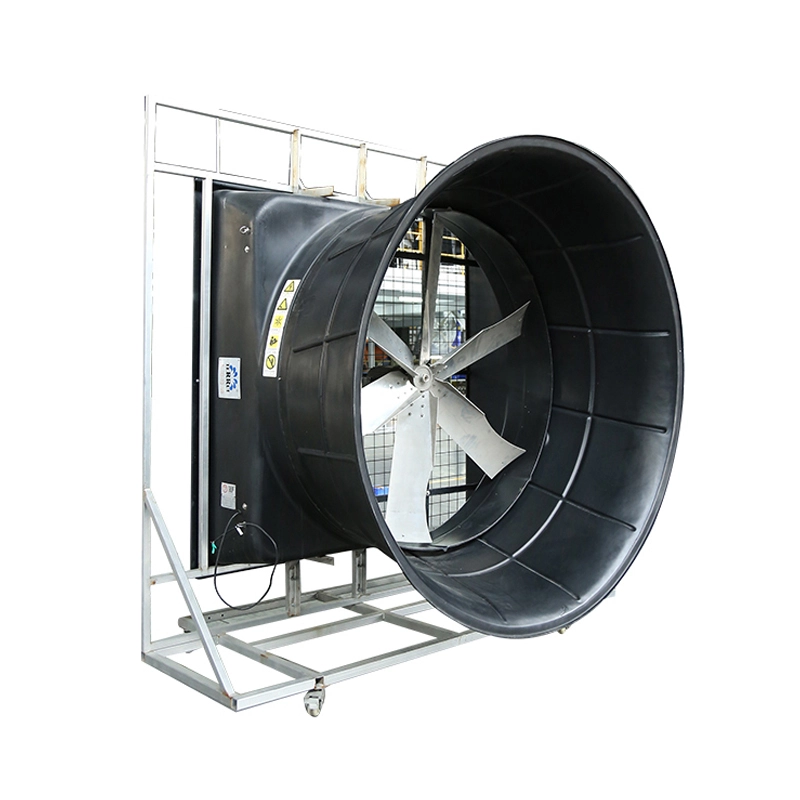
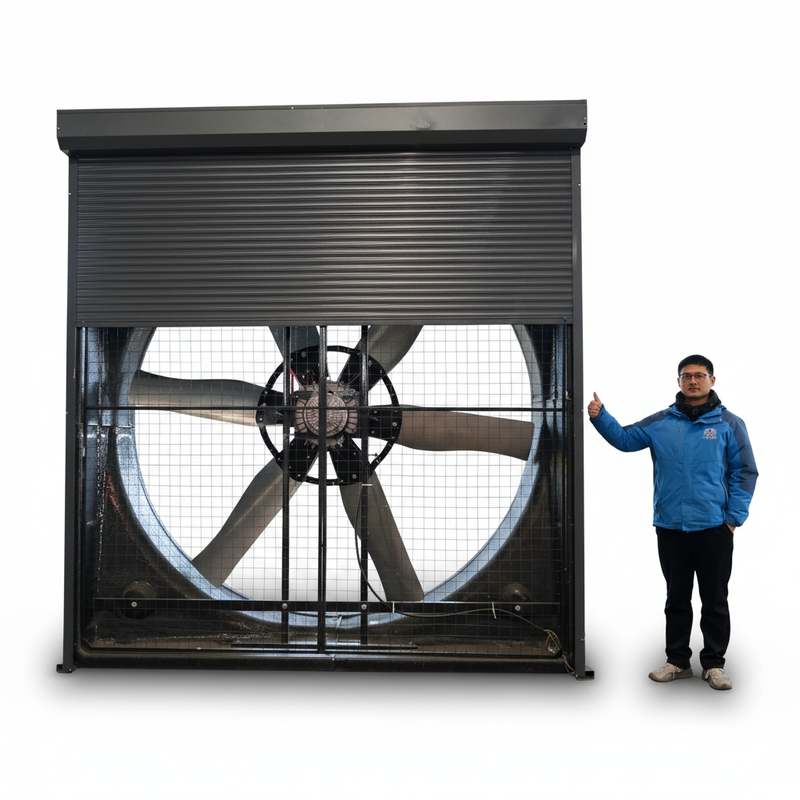
Defining an exhaust fan in a high-risk bay requires looking past the surface. It is a volumetric displacement engine. A 98-inch exhaust fan isn't just "big"; it is engineered to handle a massive air-mass transfer of 230,000 m³/h. The geometry of the venturi housing is critical here. It’s designed to compress the air at the intake and accelerate it through the discharge, creating a laminar flow that prevents the "stagnant eddies" that trap toxic gases in the corners of a production bay.
The material science of a Terrui exhaust fan centers on Fiberglass Reinforced Plastic (FRP). This isn't just "plastic." It is a composite of high-strand-count glass fiber and chemically inert vinylester resins. This specific resin-to-glass ratio ensures the exhaust fan remains non-reactive to sulfuric acid, ammonia, and caustic vapors. Unlike galvanized or stainless steel, which suffer from molecular pitting, FRP remains structurally solid. When you ramp an exhaust fan to its max RPM during a thermal runaway, the blades face extreme centrifugal force. Metallic blades weakened by corrosion will shear off; FRP blades, however, maintain their structural density and geometric profile, ensuring the purge continues without mechanical hesitation.
The "brain" of this exhaust fan is the Variable Frequency Drive (VFD) coupled with Modbus/RS485 digital logic. This isn't a simple on/off switch. It’s a responsive safety node. The RS485 bus allows the exhaust fan to communicate directly with gas detectors. It bypasses the human factor. When VOC levels hit a pre-set parts-per-million (PPM) threshold, the exhaust fan motor receives an instantaneous command to ramp from idle to peak capacity. This second-level response is the only way to clear a zone before contaminants infiltrate adjacent working bays.
Why: The Fatal Mistake of Manual Control and Metallic Decay
Most facility managers view an exhaust fan as a commodity. This is a fatal mistake in the chemical processing landscape of 2026. The reasons to upgrade are based on hard mechanical failures and the physics of human reaction times.
The Invisible Killer: Pitting Corrosion in Metal Units
In a chemical synthesis zone, the air is aggressive. If you use a metallic exhaust fan, you are inviting "pitting corrosion." These are microscopic holes that eat through the blade’s internal lattice. You can’t see the damage from the ground. But the moment you need a high-speed emergency flush, that exhaust fan becomes a bomb. The centrifugal stress causes the weakened metal to disintegrate. By switching to an FRP exhaust fan, you eliminate this structural decay. FRP is inert. It doesn't pit. It doesn't rust. It ensures that when the emergency signal is sent, the blades actually hold together at 1.5kW peak torque.
The 180-Second Death Zone
Safety data shows that during a VOC leak, the gap between detection and a toxic threshold breach is often less than three minutes. We call this the "180-second death zone." If your exhaust fan relies on an operator smelling a leak and walking to a control panel, the delay is fatal. This "Human-in-the-Loop Latency" is the primary cause of industrial health breaches. An automated exhaust fan removes the person from the loop. It triggers the millisecond a sensor identifies the PPM spike, neutralizing the threat before it can disperse into adjacent office or staging areas.
Thermal Stabilization vs. Reactor Runaway
Chemical reactions aren't steady; they have "heat spikes." A reactor running at the edge of its thermal limit can fail if the ambient air temp rises by even 5 degrees. An exhaust fan capable of 230,000 m³/h acts as an emergency heat evacuator. It stabilizes the room temperature, preventing a secondary thermal crisis. This volumetric power is essential for maintaining "thermal equilibrium" in high-density processing zones.
How: The Engineering Protocol for Automated Safety Grid Deployment
Implementing a fail-safe exhaust fan network is a multi-phase process that requires precision synchronization of mechanical force and digital logic.
Phase 1: Concentration Zone Mapping and Sensor Arrays
You don't just hang an exhaust fan anywhere. You start by mapping "Concentration Zones"—areas where gas accumulation is physically inevitable due to building geometry or valve density. Each exhaust fan must be paired with a local sensor array. This allows for a "localized strike." If a leak occurs in Bay B, the exhaust fan in Bay B initiates a high-speed purge immediately. It boxes in the gas, preventing it from floating across the entire facility.
Phase 2: Modbus Register Tuning and RS485 Integration
The exhaust fan motor is connected to a VFD programmed with a "Safety Gradient." We use the RS485 bus to establish the communication protocol. As PPM levels rise, the exhaust fan speed increases proportionally. This isn't a linear curve; it's a safety-first ramp. We tune the Modbus registers to ensure the exhaust fan hits 100% capacity within 10 seconds of a trigger. This "speed-to-max" is the most critical metric in toxic gas evacuation.
Phase 3: Shutter Synchronization and Path Clearance
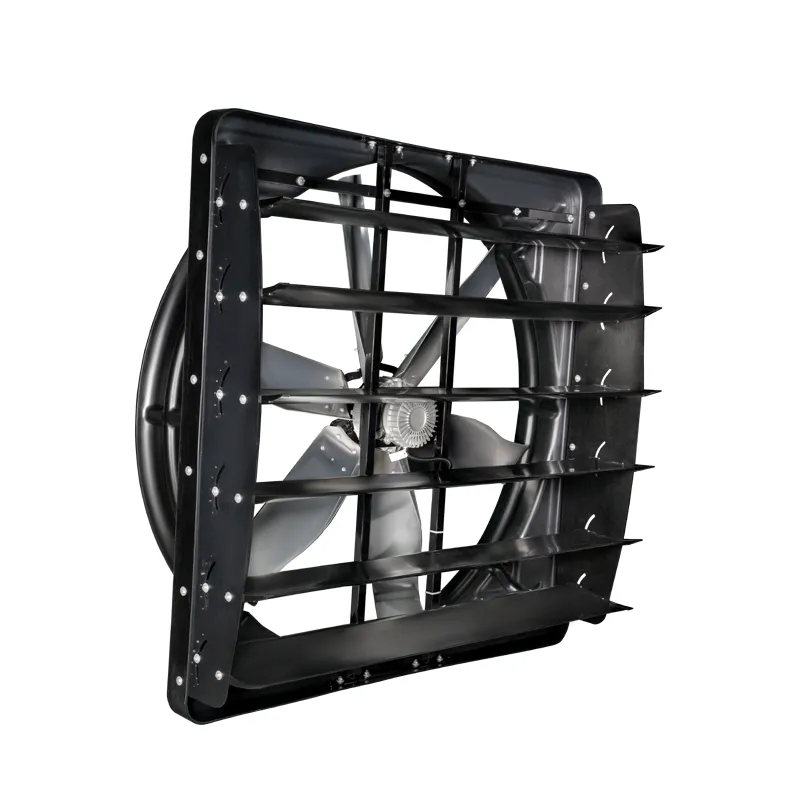
An exhaust fan is only as good as its air path. We use reinforced integrated shutters that stay hermetically sealed when the unit is idle. This keeps external humidity and contaminants out. When the exhaust fan activates, a high-torque actuator flips the shutters open in perfect sync with the motor ramp-up. We verify this with a physical limit switch to ensure the air path is 100% unobstructed before the motor hits peak RPM, preventing back-pressure damage to the FRP blades.
Phase 4: Local Intelligence and Redundancy Setup
In a chemical plant, you assume the network will fail. We configure each exhaust fan with "Local Intelligence." This means the unit is hardwired directly to a local gas sensor, bypassing the central plant BMS. If the main server crashes or the Ethernet cables melt, the exhaust fan still gets the signal to initiate a high-speed purge. This redundancy is the core difference between a ventilation utility and a safety infrastructure.
Phase 5: Post-Installation Volumetric Auditing
Once the exhaust fan grid is live, we don't just "turn it on." we perform a "Smoke Trace Test." We release non-toxic smoke at the furthest point from the fan and time how long it takes for the exhaust fan to achieve a 100% air turnover. If we find "dead pockets," we adjust the VFD frequency or the blade pitch. We ensure the exhaust fan is delivering its rated 230,000 m³/h in real-world conditions, not just on a spec sheet.
FAQ: Critical Inquiries for Exhaust Fan Procurement
Q1: How does the exhaust fan respond if the plant's central network goes down?
We program our exhaust fan units with "Local Intelligence." By hardwiring the unit directly to local gas sensors, the fan can initiate a high-speed purge even during a total BMS (Building Management System) blackout. This is a non-negotiable redundancy for chemical zones where network reliability can be compromised during a crisis.
Q2: Is the Fiberglass (FRP) used in the exhaust fan truly fire-retardant?
Absolutely. We use specialized resin blends in our exhaust fan components that are self-extinguishing and meet the highest industrial fire safety codes. In a chemical manufacturing zone, standard plastic or cheap composites are a fuel source; Terrui FRP is a fire-resistant barrier designed to maintain structural integrity at elevated temperatures.
Q3: Can these exhaust fan units manage a sudden heat spike from a chemical reactor?
Yes. A 98-inch exhaust fan is engineered for emergency heat evacuation. By moving 230,000 m³/h of superheated air, the fan stabilizes the ambient temperature around the reactor, preventing thermal runaway from escalating into a secondary explosion. It acts as a thermal stabilizer for the entire bay.
Q4: Will the high-velocity exhaust fan airflow interfere with our existing ceiling fans?
They are actually designed to be complementary. While the exhaust fan removes the toxic core gas, an industrial ceiling fan kills the "Dead Pockets" near the floor where heavy vapors often linger. Together, they create a 3D atmospheric flush that ensures no pockets of stagnant air remain after a leak.
Q5: Why is Modbus/RS485 considered better than simple manual control for an exhaust fan?
Digital logic removes the human factor. Manual control introduces a dangerous "latency gap" where an operator must react to an alarm. An exhaust fan on a Modbus network reacts instantly to sensor data. It ensures a second-level response to gas spikes, purging the air before the threat can disperse.
Q6: What is the real-world maintenance schedule for an FRP exhaust fan?
Maintenance for an FRP exhaust fan is minimal because the material is corrosion-proof. Unlike steel units, you don't need to check for rust or pitting every six months. We recommend a simple annual audit of the VFD connections and the shutter actuators. It is a low-OPEX solution for 24/7 chemical environments.
Conclusion
The era of "manual ventilation" is over. For any facility managing toxic or volatile compounds, an automated exhaust fan grid is the only viable safety protocol. By combining the volumetric power of a 230,000 m³/h purge with the corrosion-proof integrity of FRP, Terrui provides a proactive safety barrier that neutralizes risks before they become disasters. This is about building a digital and mechanical fortress around your production bay. If you are ready to eliminate the risks of pitting corrosion and human latency, contact our engineering team today for a technical consultation or download our latest exhaust fan specification catalog for your 2026 upgrades. Our experts are ready to map your facility and provide a customized deployment plan that meets the highest global safety standards.


 English
  中文
中文  日本語
日本語  français
  Deutsch
  Español
  русский
  português
  العربية