Summary
Fan breakdowns in busy farm barns rarely start with a sudden motor blowout you can see coming. Most times, it is invisible mechanical forces working quietly in the background. Micro-vibrations—caused by tiny weight gaps as small as 0.1 grams across spinning blades—slowly shake heavy equipment apart. Turning at 750 r/min, a 38-inchblade array throws out sharp centrifugal force the second mass strays off center. Over time, those steady vibration waves travel right into motor bearings, rattle frame bolts loose, and weaken structural mounts.
Swapping out wobbly fans for a 【38-inch direct-drive panel fan】 stops this structural fatigue before it starts. By shaping four 304 stainless steel blades in a single cold-press riveting step and balancing every assembly across two dynamic planes, this setup stops rotational wobble, cuts out frame chatter, and protects air output over thousands of continuous operating hours.
What
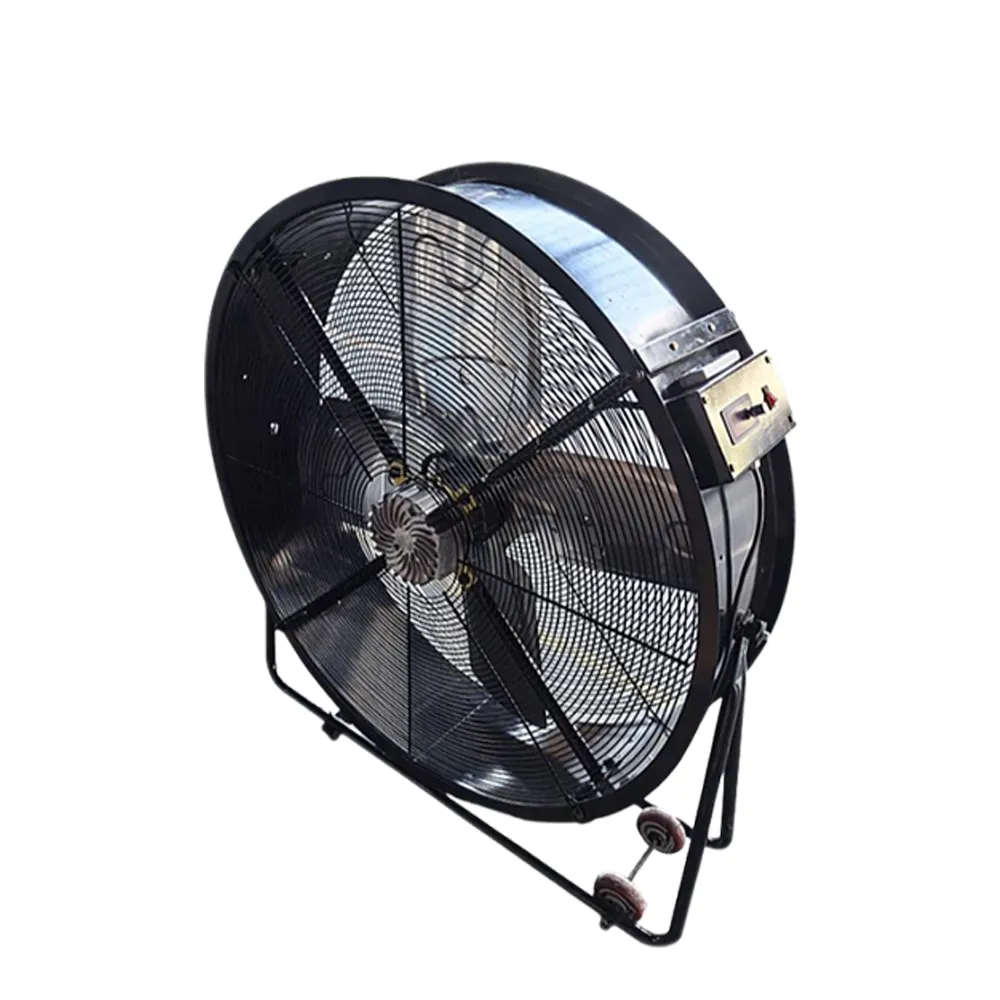
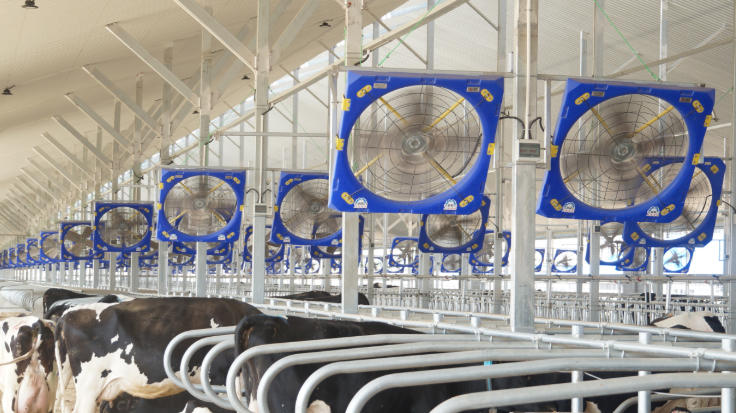
Let's talk real build specs on this 【38-inch low-vibration panel fan】. Built for quiet, high-volume air movement down in animal housing, the outer frame sits inside an 1140 x 1140 x 300 mm double-layer polyethylene plastic box. Inside, four 1mm-thick 304 stainless steel blades link directly onto an outer-rotor permanent magnet brushless DC motor.
Wired for standard 380V–480V 3-phase farm power, this direct-drive panel fan pushes up to 27,000 m³/h of fresh air while pulling just 410W of power at 750 r/min. To guarantee smooth, wobble-free spinning out of the box, every single unit goes through a 100% dynamic balance test as part of a 23-step factory quality check, keeping sound levels under 69 dB.
Why
Looking at basic rotational physics shows why tiny weight gaps ruin farm fans fast. When a 1-meter blade set spins at 750 r/min, any uneven mass creates a constantly shifting centrifugal force . An uncorrected weight gap of just 0.1 grams out at the blade tip hits the motor shaft with a continuous radial force of about 0.3 Newtons on every single spin.
Multiply that by millions of daily rotations. That constant hammering strips away the thin oil film inside motor ball bearings, pitting steel raceways and loosening wall mounts. On top of that, blade wobble changes the air angle, creating turbulent eddies that waste electricity and make the fan louder. Upgrading to a dynamically balanced panel fan tackles this issue right at the source:
Single-Stage Riveting: Joining 304 stainless blades in one cold-press step keeps weight distribution perfectly equal across all four blades.
Two-Plane Balancing: Fine-tuning balance across two planes stops rotational wobble, protecting internal motor bearings and keeping airflow smooth and steady.
How
Single-Stage Riveting and Metallurgical Consistency
The structural balance of this 38-inch panel fan starts right during blade stamping. Instead of welding or bolting individual blades to a center hub—methods that introduce heat warping and inconsistent bolt weights—all four 304 stainless steel blades join in a single-stage precision riveting operation. This cold-forming process guarantees matching pitch angles, identical rivet compression, and uniform thickness across every blade. The natural stiffness of 1mm 304 stainless steel stops blades from flexing during speed shifts, preserving geometric symmetry under heavy load.
Two-Plane Dynamic Balance Calibration
Once assembled, every blade-and-motor rotor combo goes straight onto a high-sensitivity two-plane dynamic balancing machine. Sensors read radial force vectors and phase angles in real time while spinning at full operational speed. Workers adjust mass until static and dynamic unbalance drop down into micro-gram ranges. This alignment aligns the main axis of inertia directly with the geometric axis of rotation, wiping out parasitic radial forces before the unit ever drops into its PE frame.
Vibration Suppression and Component Longevity
Cutting micro-vibrations delivers direct operational wins for the entire assembly. Turning smoothly without centrifugal wobble, the outer-rotor PMBLDC motor sees minimal radial bearing loads, extending grease life and preventing early bearing failures. The double-layer PE box stays completely free from structural hums, stopping chatter noise and protecting the pre-drilled wall mounting points. Operating at a quiet 69 dB or lower, the fan maintains peak efficiency (65.8 m³/h per watt) without shaking the barn frame.
FAQ
What causes micro-vibration in livestock panel fans?
Micro-vibration usually comes from mass unbalance across spinning blades, uneven blade pitch angles, or slight weight differences in hardware. At high speeds, these small flaws create alternating radial forces that rattle the assembly.
How does a 0.1g imbalance affect fan lifespan over time?
Even a 0.1g imbalance at the outer blade tip creates continuous radial forces during rotation. Over time, these cyclical stresses break down bearing grease, pit steel raceways, loosen mounting bolts, and fatigue the fan frame.
Why is single-stage riveting better than welding fan blades?
Welding causes localized heat distortion that changes metal density and blade shape. Single-stage cold riveting locks 304 stainless blades with uniform mechanical pressure, maintaining consistent weight and pitch across all four blades.
Does dynamic balancing improve airflow and energy efficiency?
Yes. A dynamically balanced circulation fan minimizes wobble and blade flutter while maintaining a steady aerodynamic angle of attack. This smooth rotation cuts out tip turbulence, maximizing air volume output per watt of power used .
What quality checks are conducted on the fan assembly before shipping?
Each fan undergoes a 23-step quality inspection, including 100% testing for dynamic balance, running noise , vibration amplitude, rotational alignment, blade tip speed, total airflow volume, and overall motor efficiency.
What are the motor and power specifications for Model YBA002EC?
The unit uses an outer-rotor PMBLDC direct-drive motor running on a 3-phase 380V–480V supply. It draws a light input current of 1A at 410W while running at a steady 750 r/min.
Conclusion
Keeping an industrial ventilation fan running reliably over the long haul means controlling the subtle physical forces that shorten equipment life. Investing in a precision-balanced direct-drive panel fan gives farm operators a practical, high-value solution to mechanical fatigue.
By combining single-stage 304 stainless blade riveting with strict dynamic balance testing, this fan eliminates the main cause of early bearing wear and frame damage. Pushing out 27,000 m³/h of air on just 410W, backed by an IP55 rating and a 23-step factory inspection, it delivers quiet, low-maintenance climate control season after season.


 English
  中文
中文  日本語
日本語  français
  Deutsch
  Español
  русский
  português
  العربية