Create Time: 05 ,19 ,2026
The 10-Meter Problem: Why Standard Ventilation Fails
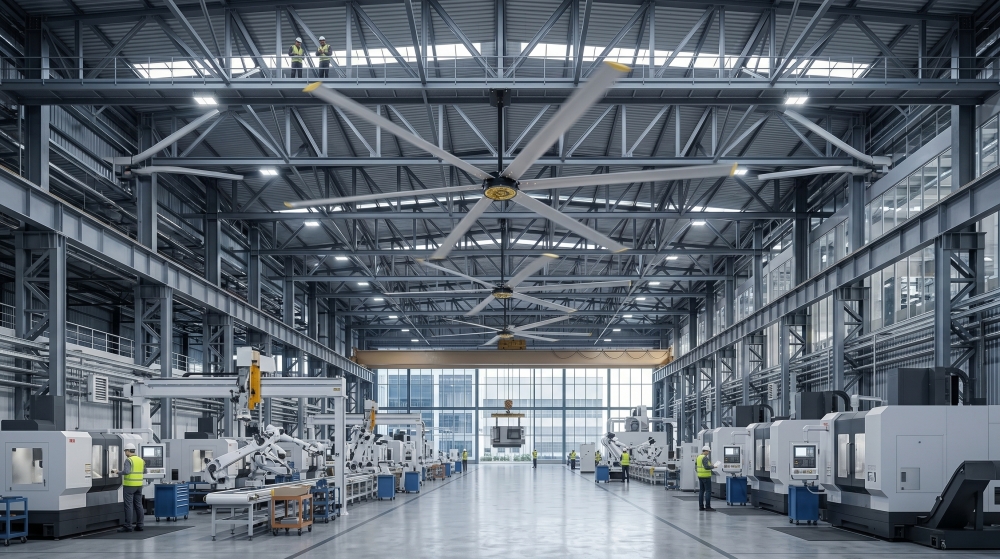
In facilities where the deck height exceeds 10 meters, you aren't just dealing with heat—you are dealing with a massive "energy trap." Stagnant air layers accumulate at the roofline while moisture settles on the concrete floor. This is Thermal Stratification and Sweating Slab Syndrome (SSS). The Terrui TR-Series Industrial Ceiling Fan is not a luxury; it is a high-torque HVLS intervention designed to force a total atmospheric reset. By utilizing IE5 Permanent Magnet Synchronous Motor (PMSM) technology, these units displace massive volumes of air to break the boundary layer before condensation can ruin your inventory.
I. Direct-Drive vs. The "Gearbox Tax"
Traditional industrial fans are burdened by high-friction transmission assemblies. In the engineering world, we call this the "Gearbox Tax"—the constant loss of kinetic energy through heat and mechanical drag.
Pure Torque Application: Terrui’s direct-drive architecture couples the EC motor directly to the hub. There is no intermediate gear layer. This means 100% of the electromagnetic torque is applied to the airfoils. For the TR-24 model (7.3m diameter), this translates to an immediate high-volume floor jet with a daily power footprint of just 1.5 - 3 kWh.
Maintenance & Liability: Installing equipment at 10+ meters creates a long-term servicing nightmare. If a gearbox leaks oil or a gear wears out, you have to rent a scissor lift and shut down the floor. Terrui’s solid-state powertrain removes these failure points. It is a "set-and-forget" infrastructure node that eliminates the risk of oil contamination on the inventory below.
II. TR-Series Capacity Audit (Field Specifications)
Choosing the right Industrial Ceiling Fan depends on the "floor jet" requirement of your specific layout. Below is the technical output data for the TR-Series range:
Unit Model | Blade Span | Power Draw | Max Airflow | Max RPM | Application Scope |
TR-8 | 2.4m (8ft) | 0.55kW | 3,500 m³/min | 150 RPM | Small work cells / narrow aisles |
TR-12 | 3.6m (12ft) | 0.55kW | 6,500 m³/min | 110 RPM | Loading docks / staging areas |
TR-18 | 5.5m (18ft) | 1.1kW | 11,200 m³/min | 75 RPM | Mid-sized assembly lines |
TR-24 | 7.3m (24ft) | 1.5kW | 14,800 m³/min | 55 RPM | High-bay logistics & ag-hubs |
Note: All units are mathematically balanced to limit acoustic output to 36-40 dBA, protecting livestock from stress and ensuring staff comfort.
III. Humidity Logic: Why Temperature Control is a Mistake
Most industrial fans are programmed to speed up based on "how it feels" (temperature). In moisture mitigation, this is a flawed strategy. Terrui utilizes a specialized humidity-triggered protocol via the DZJ902 Gateway and DGY601485 moisture sensors.
The Dew Point Strike: Instead of following a thermal curve, the system monitors how close the ambient air is to the dew point. When Relative Humidity (RH) spikes, the fan kicks into high gear.
Active Evaporation: By driving a horizontal floor jet at 14,800 m³/min (TR-24), the system physically disrupts the boundary layer where condensation forms. Once the floor is dry and moisture levels stabilize, the system shuts down automatically. We prioritize dry air over the energy-wasting complexity of variable thermal speeds.
IV. Structural Integrity: 6063-T6 & Metal Heat Sinks
Industrial environments are brutal on plastic and composites. The Terrui EC motor is encased in a heavy-duty metal housing that doubles as a massive heat sink. In non-air-conditioned manufacturing plants, this ensures the motor remains within its optimal thermal range even during 24/7 high-torque operation.
The fan blades are extruded from premium 6063-T6 aviation-grade aluminum. Look inside the profile: these airfoils feature internal multi-chamber longitudinal ribs. This internal scaffolding is what prevents "blade flutter" or aerodynamic twisting when the motor hits its peak torque curve. You get a uniform, downward air column from the root to the tip.
V. ROI Analysis: Winter Destratification
The return on investment (ROI) for a Terrui Industrial Ceiling Fan isn't just a summer metric. During winter, heat generated by your HVAC system rises and gets trapped at the roofline (up to 25°C). The floor remains freezing. By running the fan at a low, steady speed, you reclaim that trapped heat and push it back to the occupied zone. Real-world impact: This process, known as HVAC Destratification, typically reduces a facility's primary heating bill by 25% to 30%.
VI. Conclusion: Purpose-Built Environmental Control
Transitioning to the Terrui TR-Series represents a shift from simple "air circulation" to purposeful Environmental Infrastructure. By combining IE5 motor efficiency with automated, sensor-triggered humidity strikes, we provide a fail-safe mechanism for modern industrial landscapes. Whether it's protecting sensitive inventory from moisture or slashing energy overhead, Terrui is engineered for the precision demands of the modern warehouse.


 English
  中文
中文  日本語
日本語  français
  Deutsch
  Español
  русский
  português
  العربية