Summary
A 6 blade outdoor ceiling fan is not a scaled-up domestic fan. Once blade diameter reaches the 24 ft class, the unit behaves like a piece of building services equipment: it stirs an enormous volume of air slowly, runs on a motor designed for continuous duty, and has to survive dust, humidity and temperature swings without asking for maintenance.
That changes what you check before buying. Diameter sets how far the air reaches. Airflow and power together tell you the efficiency. Drive mode decides noise and maintenance. Blade material decides whether the fan still runs smoothly in year five. And the motor class decides how much of your electricity bill the fan owns.
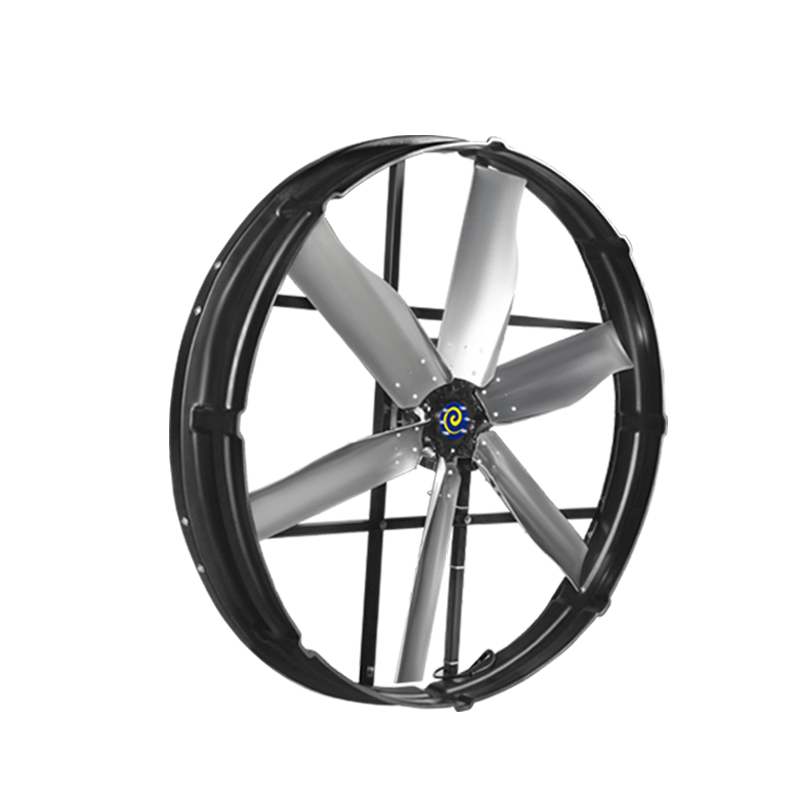
This guide walks through those five specs using Terrui's 24FT six blade ceiling fan — part number YBA073AL06EC, rated 1500 W, 15000 m³/min, direct drive, 7300 mm blade span — as the worked example, and covers where these fans genuinely belong outdoors.
What Makes an HVLS Fan Different From a Warehouse Fan
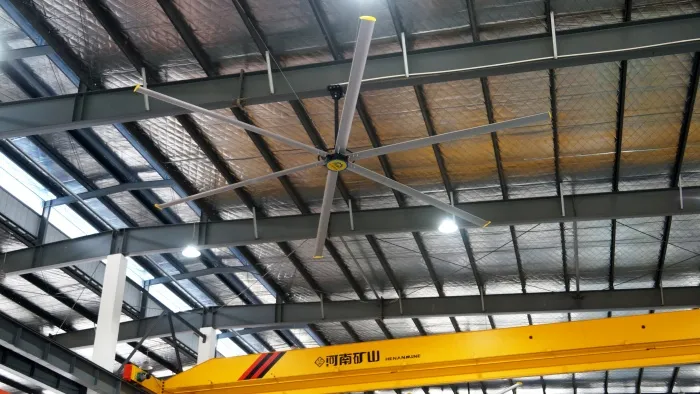
HVLS stands for high volume, low speed. The idea is simple and worth stating plainly: instead of pushing a narrow column of fast air across a small area, an HVLS fan turns slowly and moves a very large mass of air across a very large floor. The 24FT six blade ceiling fan is a good illustration. Its blades span 7300 mm, roughly 24 feet across, and it turns slowly enough that you feel the result as a gentle, continuous drift rather than a draught.
That behaviour is what makes these fans useful in tall, open buildings. Fast, narrow airflow loses its energy to friction and to mixing long before it reaches a worker standing at the far end of a shed. A slow-moving, wide air column travels much further and keeps its shape, which is why HVLS fans are specified in workshops, gymnasiums and large livestock buildings rather than at workbenches.
Six blades rather than three or four is a balance choice. More blades mean more air moved per revolution and a smoother, quieter output, at some cost in drag. Fewer blades spin faster for the same airflow and get noisier. For a building where people work underneath the fan all day, the six-blade layout is usually the sensible middle ground — and Terrui's own range reflects that, with six-blade models from 16FT up to 24FT. Where a project wants the largest possible air mass and can accept a heavier unit, an eight-blade ceiling fan is the other way to go, so it is worth pricing both before you settle on a blade count.
One caution about terminology, since it sends buyers to the wrong product. A "24 inch" ceiling fan and a "24FT" ceiling fan are not the same machine, and search results mix them constantly. Twenty-four inches describes a domestic fixture measured by blade span in inches. The unit described here spans 7300 mm, roughly twelve times that diameter and an entirely different class of installation. If a quotation for a "24 inch fan" arrives with a 24 ft price tag, or the reverse, stop and re-read the specification before anything is ordered.
Why 6 Blade Ceiling Fans Work as Outdoor Ceiling Fans
Indoor HVLS fans are usually protected by the building envelope. An outdoor installation has no such cover, so the fan itself has to tolerate what the weather throws at it.
The first requirement is a sealed, maintenance-light motor. Terrui's 24FT model uses an external rotor permanent magnet synchronous motor, described as efficient, energy-saving, quiet, stable and maintenance-free for life, with operating efficiency above 80%. Direct drive matters more outdoors than indoors because it removes the belt that would otherwise be the first thing to perish in sun, dust and temperature cycling.
The second requirement is a blade that does not absorb water or corrode. This fan's blades are made from 6005 aluminium alloy, chosen for balance, air volume and low noise. The blade surface uses a large-scale fluid mechanics simulation design with increased wall thickness and four stiffeners inside the cavity, finished with electrostatic spray treatment that the manufacturer describes as wear-resistant and easy to clean. Aluminium does not swell with humidity the way timber can, and the coating gives dust and grime less to cling to.
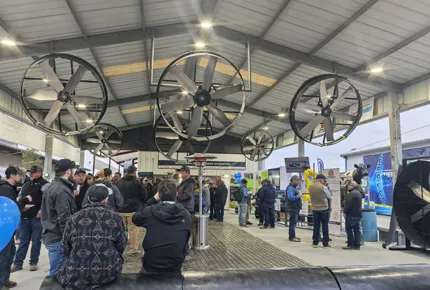
The third requirement is application fit. Terrui lists machining workshops, gymnasiums and ranch milk halls among the places these fans are used — environments that are often open-sided, high-ceilinged, or simply too large to cool with ducted air. In practice that is also where an outdoor-rated six blade ceiling fan earns its cost, because the alternative is air conditioning a space with no walls to hold it in.
How to Check the 5 Specs Before You Buy
Spec 1 — Blade diameter and coverage. Blade size is the first number to look at, because it sets the floor area one fan can serve. The published blade size for YBA073AL06EC is 7300 mm, which is the 24FT class. Larger diameter means fewer units for the same floor, which is why big buildings almost always end up cheaper per square metre with a large fan than with many small ones. Measure the mounting height too: a fan this size needs clearance and a structure that can carry it.
Spec 2 — Airflow in cubic metres per minute. The spec sheet lists 15000 m³/min. Note the unit carefully, because HVLS marketing mixes units freely and a m³/h figure against a CFM figure is one of the easiest ways to be misled in a comparison. Convert everything to one unit before you line up quotes from different suppliers, and ask what test method produced the number.
Spec 3 — Power draw and efficiency. 1500 W is the rated power for this model. Read it next to the airflow, never on its own. A fan that moves the same air for less power is the better purchase over a season, because these units run for thousands of hours. The permanent magnet motor in this fan is described as exceeding 80% operating efficiency, which is the kind of figure worth asking every shortlisted supplier to publish.
Spec 4 — Drive mode. Direct drive, in this case. Direct drive removes belts, tensioners and the routine re-tensioning that goes with them, and it eliminates belt slip as a source of lost airflow. It also tends to be quieter, which matters in a gymnasium or a parlour where people are working and talking underneath. Ask about the bearing arrangement as well; bearings are the part that eventually sets the service interval.
Spec 5 — Blade construction and surface treatment. Blade size alone tells you nothing about quality. Look for the material grade (6005 aluminium alloy here), the internal structure (four stiffeners in the cavity, increased wall thickness), and the surface treatment (electrostatic spray). A blade that is stiff, balanced and coated will run smoothly for years; a flexible or unbalanced one will develop noise and vibration, and vibration finds every weak fixing in the structure above it.
Matching the Fan to the Space
The 6 blade outdoor ceiling fan in this size class suits large footprints with high ceilings — the case it was designed for. Smaller or lower buildings rarely need that diameter, and a fan that is too big for the space wastes money twice: once on purchase, and again every hour it moves air nobody needed moving.
Terrui's own range gives three obvious step-downs within the same six-blade family: 20FT, 18FT and 16FT ceiling fans. Where a building has a mix of high clear-span areas and lower side bays, sizing each zone separately usually beats installing one diameter everywhere. For applications where the job is to push air in one direction rather than stir a volume, a different product class does it better — a wall circulation fan for air movement along a wall line, or a 72-inch panel fan where a wall opening can be used as the mounting point.
There is also a middle path for livestock buildings. Ceiling fans stir air inside the volume, while a poultry ventilation cooling fan moves air through the building and replaces it. Many large sheds use both, and it is worth understanding which problem you actually have before choosing between them. If the air inside is stale, you need ventilation. If the air is fine but the space is hot and stratified, you need circulation.
If your building needs a different air-throw pattern or a fan that seals against a wall opening when it stops, an industrial exhaust fan is the more suitable class. And where the highest priority is a wide, slow-moving air mass with no directional bias at all, the wider HVLS industrial ceiling fan range is the right starting point.
Installation and Control Considerations
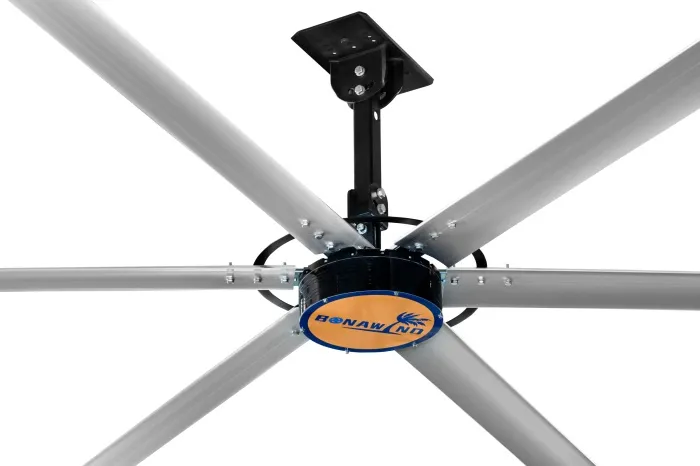
Mounting hardware is not the place to economise. A 24FT fan weighs enough that the fixing, the beam it attaches to, and the drop length all need engineering attention rather than guesswork. Work with someone who has hung fans of this diameter before, and confirm the structural capacity of the mounting point in writing.
Control is the other half of the specification. This fan is built to work with a control system, and Terrui publishes a smart touchscreen controller manual alongside the ceiling fan manual. In a large building, control is what turns a fan into a system: grouped fans, scheduled starts, and speed settings that follow the temperature through the day. It also makes the fan's operation visible to whoever manages the building, which is where the real energy savings usually come from.
Documents worth requesting before you commit: the product PDF, the ceiling fan manual, the smart controller manual, and the CE certification. Terrui lists all four for this model. A supplier who can send those quickly is a supplier who will be able to support the installation properly.
6 Blade Outdoor Ceiling Fan FAQ
How much floor area does a 24FT fan cover?
Coverage depends on mounting height and on how much air movement you need at floor level, so treat any single number with care. Diameter sets the ceiling for coverage — a 7300 mm fan covers far more ground than an 18FT unit — but the practical answer comes from a layout check on your building rather than a rule of thumb.
Is a six blade fan better than a three blade one?
Not universally, but for large HVLS diameters six blades are a sensible default. More blades move more air per revolution and produce smoother, quieter output, which suits occupied buildings. Fewer blades spin faster for the same airflow, which is noisier and less comfortable for people working underneath.
Can I use these fans in an open-sided barn?
That is one of their better applications, provided the fan is specified for exposure. Check the motor sealing, the blade material and the surface treatment, and confirm the mounting structure can take the load and the wind. Aluminium blades with an electrostatic coating, such as the 6005 alloy used here, handle humidity far better than untreated metal or timber.
What airflow figure should I compare?
Airflow in m³/min or CFM — one unit, applied to every quote you collect. Ask each supplier to state the test method behind the figure. A number without a method is a marketing claim, not a specification, and it is the single easiest thing to be misled by in this category.
Do HVLS fans need much maintenance?
Direct-drive designs have far less to maintain than belt-driven ones, since there is no belt to tension or replace. Terrui describes the motor on this model as maintenance-free for life, but bearings, fixings and blade condition still deserve a periodic inspection, especially on outdoor installations.
What controls do I need?
At minimum, speed control; in practice, a smart controller that can run grouped fans on a schedule and follow temperature. Terrui publishes a touchscreen controller manual for this range, and control is where most of the day-to-day energy saving is realised.
Conclusion
A 6 blade outdoor ceiling fan is worth buying when the building is tall, wide and hard to cool any other way — and worth buying carefully, because the wrong diameter or an unproven blade costs you for years. Check the five specs in order: diameter for coverage, airflow in a single unit of measure, power against airflow, direct drive for low maintenance, and blade construction for long-term stability. Then confirm the mounting structure and choose a control system you will actually use.
Start with the 6 blade outdoor ceiling fan and request the specification PDF, the installation manual and the CE documentation. If the 24FT span is more than your building needs, the same page links to the smaller six-blade sizes, so you can compare diameters against your actual floor plan before committing to an order.


 English
  中文
中文  日本語
日本語  français
  Deutsch
  Español
  русский
  português
  العربية